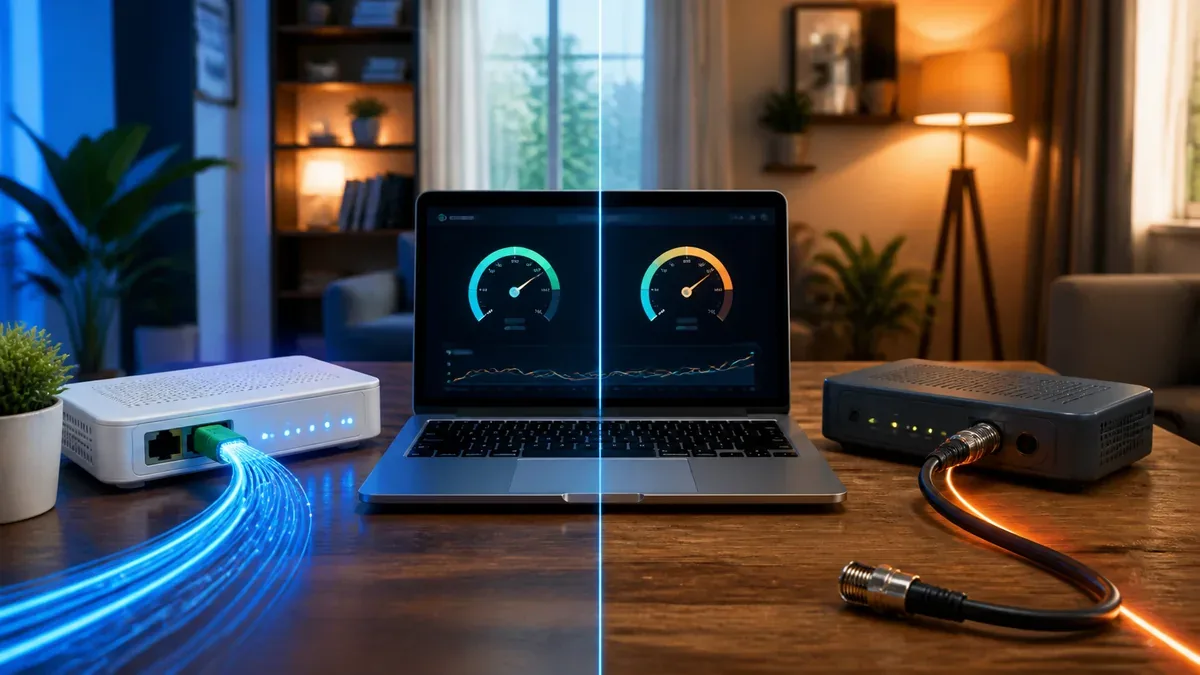
In the digital age, a slow or unreliable internet connection is more than just an annoyance—it halts productivity, disrupts online classes, and ruins family leisure time. If you live or run a small business in Chitra, Bhavnagar (near GIDC, Ganeshnagar, Shivajinagar, or Vartesh), you are likely faced with two primary options for home internet: next-generation Railtel broadband in Chitra (Fiber-to-the-Home or FTTH) or standard coaxial cable-based internet systems.
But which one is truly the best fit for your specific requirements? Sitaram Cable & Broadband Services is here to provide an honest, technical, and local breakdown of both systems, enabling you to make a well-informed decision.
Understanding the Core Technology
Before comparing speeds and prices, it is helpful to understand the underlying physical infrastructure. The medium that carries the signal from our local server nodes into your home dictates your maximum speed, latency, and resistance to monsoon weather or power outages.
1. Coaxial Cable Internet (Traditional)
Cable internet operates over the same copper-core coaxial cables that deliver television channels to your living room. The signal travels from an MSO (Multi-Service Operator) like GTPL to Sitaram's local nodes, and is then split across houses using copper splitters. While highly reliable for television transmission, copper is physically limited in its data capacity and is prone to interference over longer distances.
2. Railtel FTTH Fiber Internet (Modern)
FTTH stands for Fiber-to-the-Home. In this system, data travels as pulses of light over microscopic, flexible glass fibers. There is zero copper involved. The fiber line goes directly from Railtel's high-speed national backbone right into your home router through an Optical Network Terminal (ONT). Because light travels faster than electrical signals in copper, fiber has virtually no physical limit on speed, and is completely immune to electrical interference or signal degradation.
Head-to-Head Comparison: The Metrics That Matter
Let us look at how these two technologies perform across the key criteria that affect your daily internet experience.
1. Speed: Download and Upload
In traditional cable internet setups, download speeds are typically decent (ranging from 10 to 40 Mbps), but upload speeds are severely restricted (often just 2 to 5 Mbps). This is because the copper cables allocate most of their bandwidth for incoming data.
With Railtel fiber broadband, you get symmetric speeds. If you subscribe to a 50 Mbps plan, you get 50 Mbps download AND 50 Mbps upload. This symmetrical bandwidth is critical if you participate in Zoom calls, upload work files to Google Drive, upload videos to YouTube, or play competitive online games.
2. Latency and Ping
Latency is the delay in milliseconds for data to travel from your device to the destination server and back. Lower latency means a snappier browsing experience and zero delay in video calls.
- Cable Internet: Average latency in Chitra is usually between 40ms and 90ms. This is fine for browsing but can lead to occasional voice lag during online classes.
- Railtel Fiber: Average latency typically hovers between 5ms and 20ms. Web pages open instantly, video streams load without buffering, and voice calls feel completely real-time.
3. Monsoon Reliability
Monsoons in Bhavnagar can be challenging for standard local cables. Copper cables are highly sensitive to moisture, and rainwater entering local coaxial joint boxes can degrade signal levels, causing frequent dropouts.
Fiber cables are hermetically sealed, flexible glass. Rain, humidity, and heat have zero effect on optical signals. Furthermore, because Railtel is a national Navratna PSU under the Ministry of Railways, its primary backbones run alongside safe railway corridors, ensuring massive physical protection from accidental local excavations.
Who Should Choose Traditional Cable Internet?
Despite being older technology, traditional cable internet is a reasonable choice for certain situations:
- Light Casual Users: If your household only uses the internet for checking WhatsApp text messages and reading basic news sites once a day.
- Low Budget TV Priority: If you primarily want to watch regional cable TV and want a very basic, low-cost secondary internet line packaged onto the same cable.
Who Should Upgrade to Railtel FTTH Fiber?
If you fit any of the following profiles, Railtel fiber-to-the-home is the clear winner:
- Online Students: Students preparing for competitive exams (JEE, NEET, GPSC, UPSC) who watch continuous live video lectures on platforms like YouTube, Zoom, or local educational portals require stable, high-bitrate streaming without interruptions.
- Work-from-Home Professionals: If your job relies on virtual private networks (VPNs), video conferencing, and frequent file transfers.
- Multi-device Homes: If you have 3 to 6 family members connecting smartphones, smart TVs, tablets, and laptops concurrently. Symmetrical fiber keeps everyone happy without speed drops.
- Entertainment Seekers: Families looking to stream 4K movies on Netflix, Hotstar, or YouTube without waiting for buffering.
The Pricing Difference in Chitra
Many believe fiber broadband is expensive. However, Railtel's pricing is extremely competitive. In fact, because fiber requires less maintenance and fewer active splitters on poles, the long-term subscription cost is often equal to or lower than traditional cable internet bundles. Sitaram Cable offers plans starting at highly affordable price points with truly unlimited data caps subject to standard fair usage policies (FUP) as defined by the ISP (ranging from 1500 GB to 3500 GB per month depending on the chosen speed)—which is more than enough for heavy streaming, gaming, and multi-device households. Reach out to Sitaram Cable today to get the latest student and residential plan brochures for Chitra.
Sitaram Cable: Bringing Fiber Directly to Your Door
Installing a delicate fiber optic cable requires specialized splicing tools and highly trained technicians. At Sitaram Cable & Broadband Services, we have invested in state-of-the-art optical fusion splicers and maintain local fiber distribution boxes across every block in Chitra. Our team ensures that your FTTH installation is perfectly clean, the fiber bend-radii are safe to prevent light leaks, and your dual-band Wi-Fi router is positioned in the optimal spot of your home for maximum coverage.
Ready to Get Connected?
Call the local Sitaram Cable team for GTPL Cable TV or Railtel broadband service in Chitra, Bhavnagar.
Call Shaktisinh Now